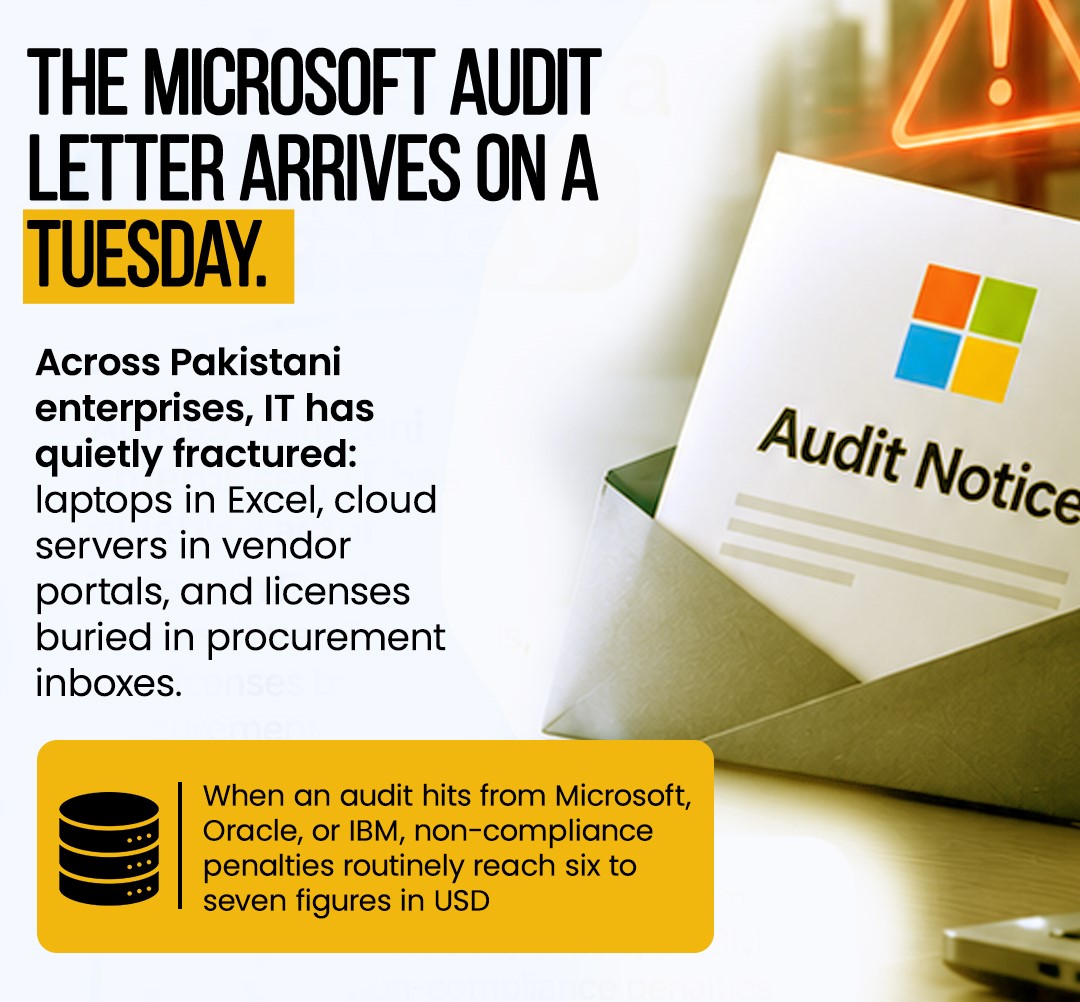
The letter arrives on a Tuesday. Microsoft wants to audit your software licenses — and your IT team has 30 days to prove compliance across assets it can’t fully account for.
If that scenario makes your stomach drop, you’re not alone. Across Karachi’s head offices, Lahore’s manufacturing plants, and Islamabad’s government contractors, enterprise IT has quietly fractured: laptops tracked in one Excel file, cloud servers in a vendor portal, and Microsoft, Oracle, IBM, and Adobe licenses scattered across departmental budgets and procurement inboxes.
Remote work, SaaS sprawl, and hybrid infrastructure have made this fragmentation dangerous. Redundant subscriptions bleed budget. Shadow IT opens security holes. And when the audit letter comes — from Microsoft, Oracle, or IBM — non-compliance penalties routinely reach six to seven figures in USD, a number that lands very differently in PKR.
Centralizing IT Asset Management (ITAM) across hardware and multi-vendor software is no longer a back-office chore. It’s an executive priority. Here’s the framework to get there.
📌 KEY TAKEAWAY
Enterprises that unify hardware and software assets into a single system of record cut software waste by up to 30% — and walk into vendor audits with evidence instead of excuses.
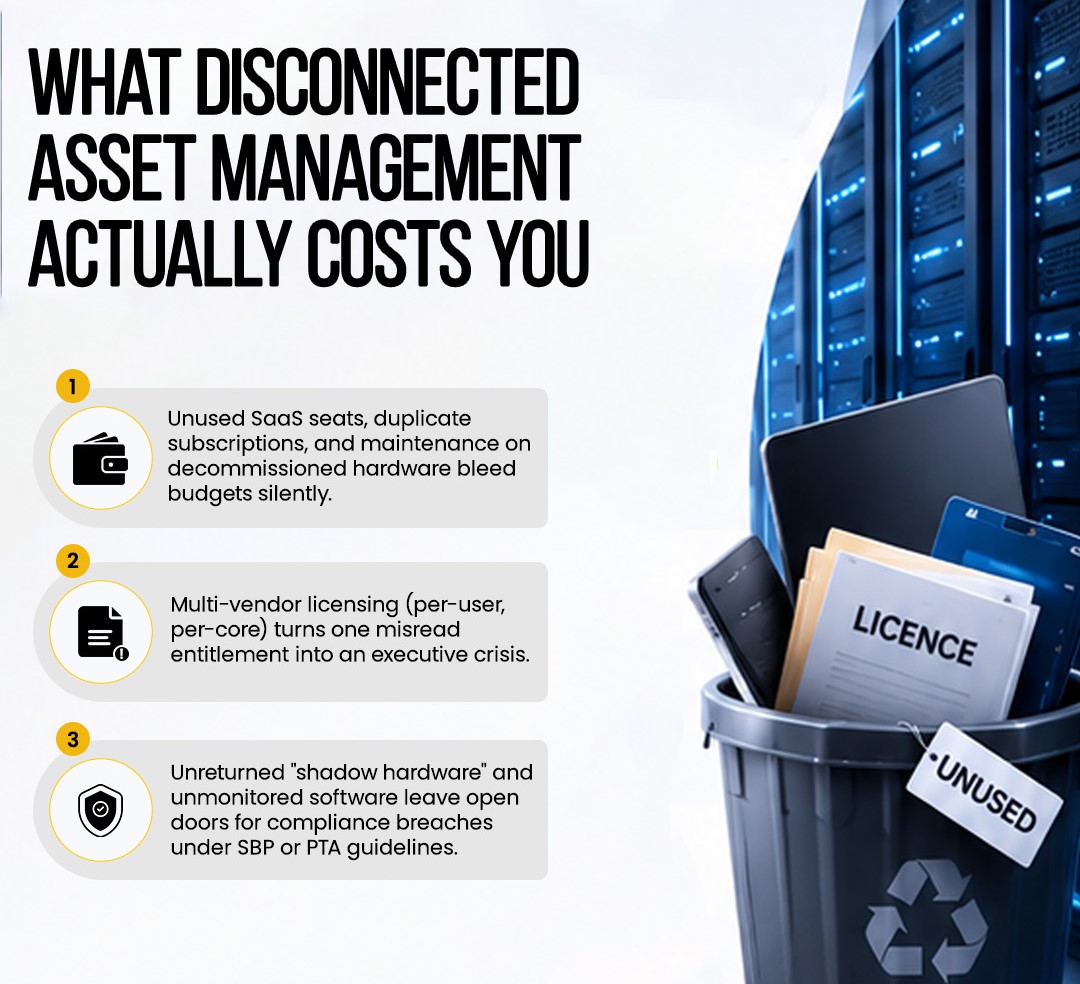
What Disconnected Asset Management Actually Costs You
When hardware and software live in separate silos — or worse, in separate departments’ spreadsheets — the damage compounds across four fronts:
💸 Financial Waste You Can’t See
Unused software seats. Duplicate SaaS subscriptions bought by two departments. Maintenance contracts on hardware that was decommissioned last year. Individually small, collectively enormous — this is the 30% waste most enterprises don’t know they’re carrying.
⚖️ Audit Vulnerability
Multi-vendor licensing is deliberately complex: per-user, per-core, named-user, concurrent. One misread entitlement in an Oracle or IBM agreement, discovered by an auditor instead of by you, becomes a seven-figure settlement conversation.
🔓 Security & Compliance Exposure
Shadow hardware — the unpatched laptop a departed employee never returned — and unmonitored software are open doors. For regulated sectors in Pakistan (banking under SBP oversight, telecom under PTA, healthcare data), an untracked asset isn’t just an IT problem. It’s a compliance breach.
⏱️ Operational Friction
Siloed asset data slows everything: onboarding takes days instead of hours, ITSM tickets stall while agents hunt for device histories, and procurement budgets are built on guesswork.
The Three Pillars of a Unified ITAM Strategy
A robust centralized ITAM practice aligns hardware discovery, software entitlement, and automated lifecycle workflows into one structure:
| Domain | What It Covers | The Centralization Payoff |
|---|---|---|
| Hardware Asset Management (HAM) | Laptops, servers, networking gear, mobile devices, IoT, end-of-life disposal | Live visibility into location, warranty status, maintenance schedules, and assignments — even across remote teams and branch offices |
| Software Asset Management (SAM) | Multi-vendor licensing: SaaS, cloud, desktop, and enterprise server licenses | Actual usage reconciled against purchased entitlements — no shelfware, no audit surprises |
| Unified ITAM Platform | HAM + SAM integrated with HR, Security, Procurement, and ITSM | A single source of truth that automates provisioning, license reclamation, and refresh cycles |
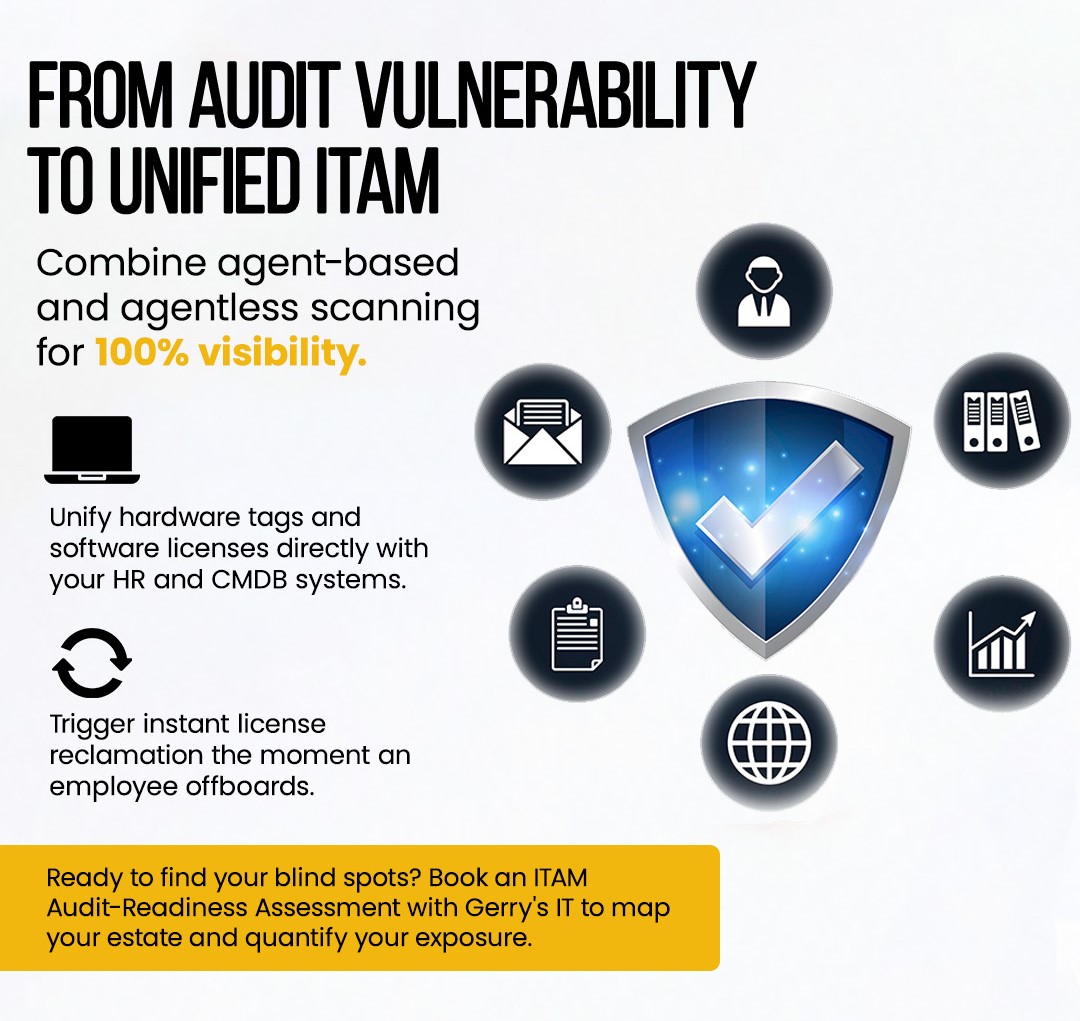
The platform row is where the value multiplies. A HAM tool that knows what you own plus a SAM tool that knows what you’re entitled to — wired into your HR system — means a resignation letter automatically triggers device recovery and license reclamation. No ticket. No follow-up email. No forgotten Adobe seat billing you for another year.
Five Practices That Separate Audit-Ready Enterprises from Audit Victims
1. Deploy continuous, automated discovery
Combine agent-based tools (deep workstation and laptop inventory) with agentless network scanning (infrastructure, mobile, and IoT assets). Anything less than 100% discovery coverage is a blind spot with a price tag.
2. Establish a single source of truth
Consolidate hardware asset tags, cloud resources, and license keys into one central platform integrated with your CMDB and HR systems. If your asset register and your org chart don’t talk to each other, neither is accurate.
3. Normalize multi-vendor software data
Microsoft counts differently than Oracle, which counts differently than IBM. Use automated license normalization to map actual installations against contract entitlements — per user, per core, named user, concurrent — so “what we deployed” and “what we bought” reconcile to the rupee.
4. Automate the full lifecycle
Build repeatable workflows from procurement and staging through offboarding and certified, eco-friendly disposal. License reclamation on employee exit should be automatic, not a quarterly cleanup project.
5. Govern cross-functionally
Form an ITAM steering committee with seats for IT Security, Procurement, Finance, and Legal. Asset policy that lives only inside IT dies in the first budget meeting.
From Reactive Tracking to Strategic Governance
Centralized ITAM isn’t about better spreadsheets. It’s the difference between discovering your license exposure in an auditor’s report and walking into renewal negotiations with usage data that puts you in control.
Enterprises that break down the silos between hardware, software, and the business systems around them transform ITAM from a defensive compliance chore into a strategic driver: lower cost, tighter security, faster operations, and audit immunity.
The audit letter doesn’t have to ruin your Tuesday.
✅ Ready to Find Your Blind Spots?
Gerry’s Information Technology helps Pakistani enterprises build unified IT asset management — from automated discovery and multi-vendor license normalization to full lifecycle governance integrated with your existing infrastructure.
We’ll map your hardware and software estate, quantify your waste and exposure, and hand you a prioritized remediation plan. No obligation, no generic sales pitch.