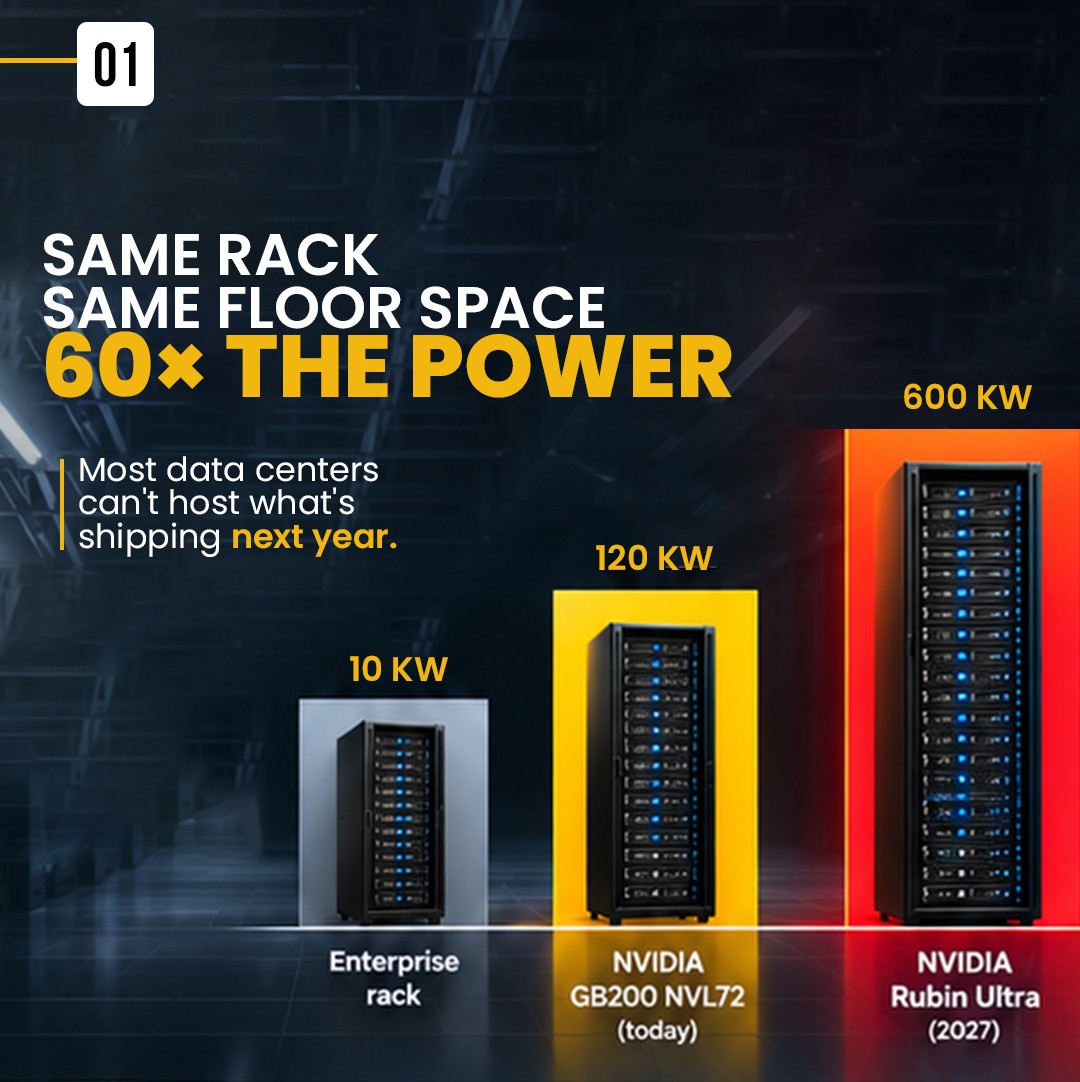
Here's a number that should make every infrastructure leader pause: a standard enterprise rack draws 7–12 kW. A single NVIDIA GB200 NVL72 AI rack draws 120 kW — ten times the power, in the exact same floor space.
And that's today's hardware. NVIDIA's Rubin Ultra "Kyber" racks, engineered for 2027, are targeting 600 kW per rack.
Meanwhile, the average data center rack has already climbed to 27 kW — up 69% in a single year — and the IEA projects global data center electricity consumption will double to roughly 945 TWh by 2030, more than Japan uses today.
The uncomfortable truth: most existing facilities physically cannot host modern AI infrastructure. Not without rethinking power, cooling, structure, and networking from the slab up. Here's what actually changes.
From 10 kW to 600 kW: The Rack Density Leap
Same 42U of floor space. Up to 60× the power:
| Rack Type | Power per Rack | Cooling Implication |
|---|---|---|
| Standard enterprise rack | 7–12 kW | Conventional air cooling |
| Volume AI (H200-class) | 40–50 kW | Beyond practical air-cooling limits |
| NVIDIA GB200 NVL72 | 120 kW | Direct-to-chip liquid cooling mandatory |
| NVIDIA GB300 NVL72 | Up to 142 kW | Liquid cooling built in |
| Rubin Ultra "Kyber" (2027) | 600 kW | Facility redesigned from the slab up |
1. Power: The Grid Is the New Bottleneck
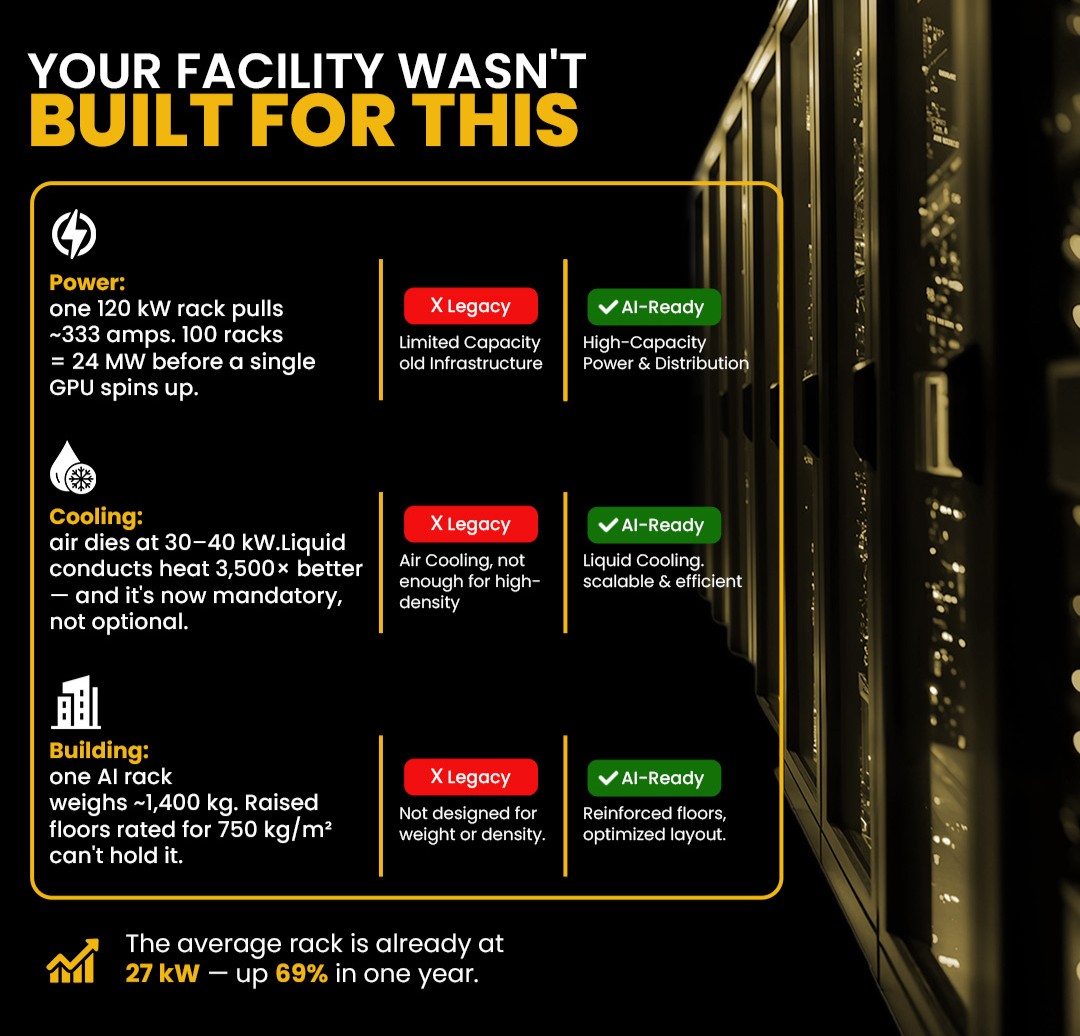
At 50–120+ kW per rack, traditional low-voltage AC distribution collapses under its own copper weight. A single 120 kW rack pulls roughly 333 amps — and if you want 2N redundancy on a 100-rack AI hall, you're provisioning 24 megawatts before a single GPU spins up.
This is why new AI facilities are being designed around:
- High-voltage and medium-voltage distribution — fewer transformation steps, dramatically less copper.
- Overhead busway systems — flexible, high-amperage power taps that handle volatile AI load spikes.
- Behind-the-meter energy — operators co-locating near dedicated renewables, and even exploring nuclear micro-reactors, because public grids can't deliver multi-megawatt blocks fast enough.
Planning rule of thumb: For a GB200 NVL72 deployment, budget 150 kW per rack position once cooling and distribution losses are included. A single row of ten racks needs 1.5 MW — ten times what the same floor space consumed five years ago.
2. Cooling: Air Is Officially Dead at the Top End
Air cooling works until about 30–40 kW per rack. Beyond that, the fan speeds required become physically impractical and deafeningly loud. Liquid, with thermal conductivity up to 3,500× higher than air, isn't an upgrade anymore. NVIDIA's GB200 NVL72 ships with direct-to-chip liquid cooling mandatory — there is no air-cooled option.
Two technologies are winning:
Direct-to-Chip (Cold Plate)
Coolant flows through micro-channel plates mounted directly on GPUs and CPUs, carrying heat away to coolant distribution units (CDUs). It handles 70–80% of server heat load, retrofits into existing architectures, and dominates the market today — a market growing from $3.3B in 2026 to $17.3B by 2032.
Immersion Cooling
Entire servers submerged in dielectric fluid. No fans, no heatsinks, and PUE ratings approaching 1.02–1.05 — numbers air cooling can only dream about.
| Cooling Method | Practical Density | Key Advantage | Best Fit |
|---|---|---|---|
| Air cooling | Up to ~30–40 kW | Familiar, low upfront cost | Legacy enterprise workloads |
| Direct-to-chip | 120 kW+ rack-scale AI | Removes 70–80% of heat; retrofittable | GB200/GB300-class deployments |
| Immersion | Very high density | PUE approaching 1.02–1.05 | New-build, efficiency-led facilities |
The market has voted: liquid cooling penetration has jumped from roughly 3% of data centers in 2021 to 37% in 2026.
3. The Building Itself Has to Change
AI racks don't just strain your power bill — they strain your floor.
- Weight. A fully populated GB200 NVL72 rack weighs 1,400 kg. Traditional raised floors rated for 500–750 kg/m² simply can't hold it. Slab-on-grade construction is now the default for AI halls.
- Space. Liquid manifolds and rear-door heat exchangers need 1.2–1.5 m of clearance behind every row — 30–50% more than legacy designs.
- Networking. AI training lives and dies by inter-node latency. Thousands of GPUs synchronizing gradients demand InfiniBand or RoCE fabrics at 400–800 Gbps — and cutting-edge facilities are exploring optical circuit switching to cut cabling congestion entirely.
4. Sustainability Isn't Optional Anymore
With data centers heading toward 3% of global electricity consumption, efficiency is now a license to operate:
- PUE and WUE. Liquid cooling's water footprint matters as much as its energy footprint — closed-loop systems with dry coolers minimize both.
- Heat reuse. Direct-to-chip return water reaches 45–60°C — hot enough to heat districts, greenhouses, and industrial processes. Waste heat becomes a revenue line.
- Workload orchestration. Inference jobs can follow the sun — shifted to when and where renewable generation peaks.
Related: See how AI-ready facility design fits into a broader infrastructure strategy through Gerry's IT infrastructure services, data centre services, and support & maintenance offerings.
The Bottom Line
The data center didn't evolve for AI. AI is forcing the data center to be reinvented — power delivery, thermodynamics, structural engineering, and network topology, all at once.
The facilities being designed today around liquid cooling, high-voltage distribution, and slab-on-grade construction will host the next decade of computing. The ones that aren't will host legacy.
Question for the comments: Is your current facility ready for even one 120 kW rack — and if not, what's the bigger barrier: power, cooling, or the building itself?
Planning an AI-Ready Facility or Retrofit?
Gerry's Information Technology designs and delivers high-density data center infrastructure — power, cooling, and structured cabling — for enterprises across Pakistan.
Frequently Asked Questions
How much power does an AI rack use in 2026?
Volume AI deployments run 40–50 kW per rack (NVIDIA H200-class). Rack-scale systems like the GB200 NVL72 draw 120 kW, the GB300 NVL72 up to 142 kW, and NVIDIA's 2027 Rubin Ultra Kyber racks are being engineered for 600 kW.
At what rack density does air cooling stop working?
Practically, around 30–40 kW per rack. Beyond that, required airflow becomes physically impractical and liquid cooling (direct-to-chip or immersion) becomes mandatory. NVIDIA's current rack-scale AI systems ship with liquid cooling built in.
What is direct-to-chip liquid cooling?
Coolant is pumped through cold plates mounted directly on processors, transferring heat to coolant distribution units. It handles 70–80% of server heat and is the fastest-growing cooling segment — projected to grow from $3.3B (2026) to $17.3B by 2032.
Can an existing data center be retrofitted for AI racks?
Partially. Direct-to-chip cooling can retrofit into existing racks, but 100+ kW densities typically demand new power distribution, reinforced slab flooring, and facility water loops — which is why many AI builds are new construction.
Sources
- Rax Data & Energy — AI Data Center Power Density Trends 2026; NVIDIA DGX GB200 rack guide (120 kW, 1,360–1,600 kg).
- Servnet GPU Rack Power Density Tracker 2026 — average rack 27 kW (+69% YoY); Rubin Ultra Kyber 600 kW (2027).
- IEA, Energy and AI (2026) — data centre electricity doubling to 945 TWh by 2030.
- MarketsandMarkets — Direct-to-Chip Cooling Market, 2026–2032.
- Mordor Intelligence — Data Center Liquid Cooling Market ($6.77B 2026 → $18.79B 2031).
Gerry's Information Technology (GIT) — powering Pakistan's enterprises with resilient, high-density infrastructure, tier-one OEM integration, and local SLA execution engineered for the AI era.